Sealed-bid advertising is a daily hidden-bid auction that hands one advertiser exclusive homepage visibility for 24 hours, with no rivals on the page and no rotation. It works best for product launches, limited-time offers, and moments where you need every visitor to see one message. Agencies use it as resellable, high-margin inventory; brands use it to buy undivided attention on a single, important day.
TL;DR:
- Exclusive homepage sealed-bid auctions are best suited for product launches, limited-time offers, and PR moments where full day-long attention is crucial.
- Bidders should estimate their campaign value, set a bid below their maximum to protect margin, and focus on reach and brand lift rather than just clickthroughs.
- Creative assets must be simple, fast-loading, and optimized for mobile since instant impact is key for undivided attention in 24-hour slots.
- Setting a verified business account and understanding auction dynamics helps in avoiding overpayment and effectively calibrating bids based on platform behavior.
- Agencies can resell verified exclusive placements by bundling them with creative services and brand-lift metrics, viewing them as strategic brand events rather than routine buys.
Table of Contents
- How Sealed Bid Auctions Work: Timing, Payment, and RTB Differences
- When Should You Use Exclusive Homepage Sealed-Bid Ads?
- How Do You Prepare, Submit, and Optimize a Sealed Bid?
- Creative Checklist for a 24-Hour Exclusive Homepage Slot
- What KPIs Actually Matter for Exclusive Placements?
- Packaging Spotlight Days for Clients
- Get Started With The Spotlight
- Sources
- FAQ
How Sealed Bid Auctions Work: Timing, Payment, and RTB Differences
A sealed-bid homepage auction runs on one rule: nobody sees anyone else’s number. Advertisers submit a single hidden bid before a fixed deadline, and the highest bid wins when the auction closes, often at midnight UTC. There’s no back-and-forth, no visible price ladder, no chance to react to a competitor’s move. You commit once, and the market clears at a set time.
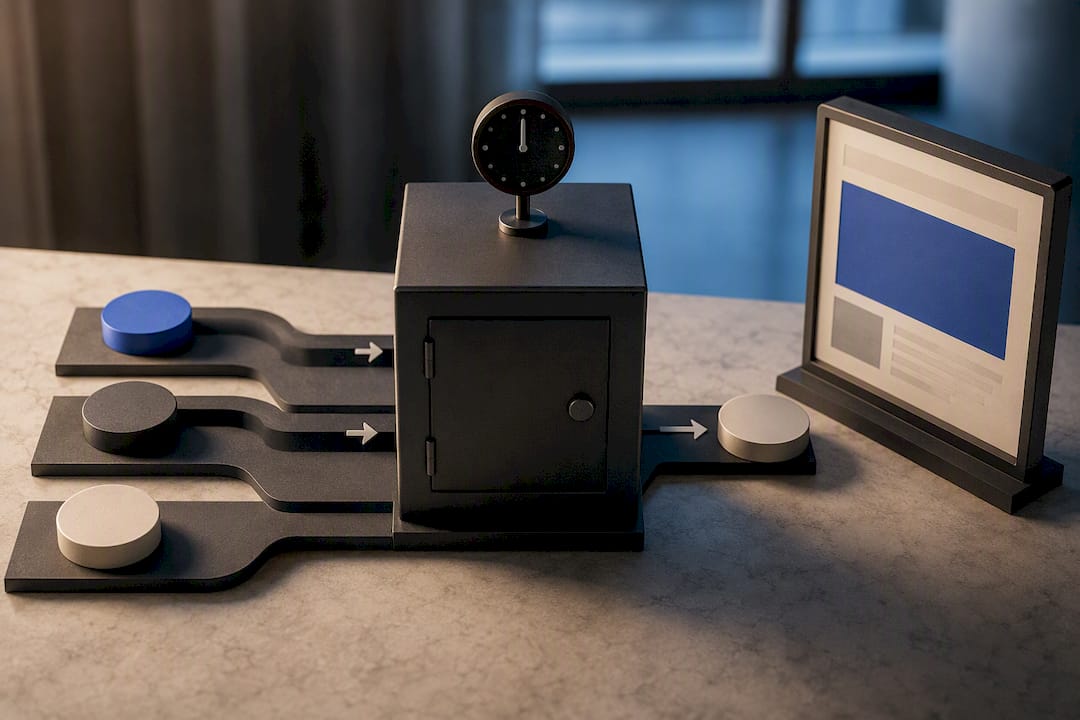
This is a first-price sealed-bid auction, meaning the winner pays exactly what they bid, not a penny less. That single fact reshapes strategy. Bidders who assume they can pad their number and get a discount, the way second-price systems work, end up overpaying. The shift toward first-price formats across digital advertising has pushed bidders toward bid shading, the practice of bidding a calculated amount below your true maximum value to protect margin while staying competitive.
Sealed-bid formats also work differently from real-time bidding (RTB) or programmatic auctions in a structural way:
- RTB sells impressions. Thousands of ads compete for individual page loads, often in fractions of a second, and multiple advertisers can appear near each other.
- Sealed-bid homepage auctions sell attention. One winner occupies the slot for the full day. Nobody else’s ad competes for that visitor’s eyes.
- Pricing logic differs too. RTB is a continuous, algorithm-driven market. A sealed-bid slot is booked once, as a flat-fee outcome, which simplifies planning for buyers who want a fixed cost instead of a fluctuating CPM.
That difference in mechanics, one item, one bid, one outcome, is what makes sealed-bid formats attractive to advertisers who want certainty over optimization.
When Should You Use Exclusive Homepage Sealed-Bid Ads?
Exclusive placement earns its premium in specific moments, not as an everyday media buy. It fits campaigns where a single day of total attention matters more than sustained frequency.
The clearest use cases:
- Product or feature launches, where you want every visitor to see the same message on day one.
- Limited-time offers with a hard deadline, where urgency and visibility need to match.
- PR moments, like a funding announcement or award, where owning the homepage reinforces the story.
- Brand campaigns built around a single creative concept rather than iterative testing.
Statistic to know: exclusive placements can generate roughly 50% more clicks than shared ad spots, according to research on exclusive-placement auction dynamics. That lift comes from removing visual competition entirely, not from better creative or targeting.
Budget expectations differ from standard media buys too. Homepage takeovers commonly run two to ten times a standard CPM, priced as a flat day rate rather than per impression, because forecasting exact daily traffic is imprecise. Treat CTR as a secondary signal here. The primary return is reach, brand lift, and the co-branding effect of being the only ad a visitor sees that day.
How Do You Prepare, Submit, and Optimize a Sealed Bid?
Winning a sealed-bid auction is less about outbidding everyone and more about knowing your number before the auction opens. Here’s the sequence that works.
- Set up a verified business account. Most platforms require B2B verification such as an EU VAT ID before you can bid, which keeps the auction limited to legitimate advertisers.
- Estimate your campaign’s incremental value. Before picking a number, calculate what one day of full share-of-voice is worth to you, based on expected brand lift, launch timing, or PR value. Auction-theory research ties optimal bidding directly to this expected effect, what economists call the average treatment effect, or ATE, of the exposure you’re buying, so estimating that value first keeps your bid grounded in real return rather than gut feeling.
- Set a maximum bid, then shade it. Because this is a first-price format, bidding your true maximum guarantees you pay full value even against a weak field. Shave your number down from your ceiling to protect margin, a practice that grew more common as platforms shifted to first-price mechanics.
- Decide your bidding cadence. Some advertisers enter every auction at a modest number to catch a low-competition day. Others save budget for one high-conviction bid tied to a launch date.
- Submit creative ahead of the deadline. Have your hero asset, CTA, and brand lockup ready before you bid, not after you win.
- Preview and monitor. Watch the live auction status if the platform offers one, then confirm your creative renders correctly before the slot goes live.
- Activate fast. Once you win, treat the first hours as your highest-value window, since traffic patterns and social sharing often peak early in the 24-hour cycle.
Pro Tip: Don’t bid your absolute ceiling on your first auction. Enter a modest bid once or twice to read the platform’s typical winning range, then calibrate your real bid once you understand the competitive floor.
Creative Checklist for a 24-Hour Exclusive Homepage Slot
A single day of exclusive visibility is wasted on cluttered creative. Keep the message tight: one primary offer, one call to action, and a clear brand lockup that reads instantly, even to a visitor glancing for two seconds.
Technical readiness matters just as much as the message:
- Build responsive assets for at least three breakpoints (mobile, tablet, desktop), since homepage traffic skews heavily mobile on most publisher sites.
- Stick to standard file types (JPEG, PNG, or a lightweight MP4) and keep file sizes small enough that load time doesn’t lag, since poor optimization can break page UX during a takeover.
- Avoid heavy rich media, autoplay audio, or intrusive animation. Publishers protect page experience closely, and overly aggressive creative risks rejection or early pull.
- Check accessibility basics: readable contrast, alt text, and legible type at small sizes.
Simple, fast-loading creative consistently outperforms ambitious rich media in exclusive slots, mostly because the format’s power comes from undivided attention, not visual complexity.
What KPIs Actually Matter for Exclusive Placements?
Click-through rate tells only part of the story on an exclusive homepage day. Because you’re paying for total attention rather than incremental impressions, the right KPIs shift toward reach and perception, not just clicks.
Track these primarily:
- Reach and unique visitors for the full 24-hour window, compared against typical daily traffic.
- View-through rate, capturing visitors who saw the ad but converted later.
- Aided awareness and brand-lift survey results, if you can run a lightweight pre/post survey.
- Assisted conversions, since exclusive placements often influence a purchase decision days after the exposure.
Why CTR alone misfires here: a visitor who sees your brand as the sole homepage message for a day, then converts a week later through a different channel, never shows up in your click data. Measurement for exclusive placements should favor brand-lift studies and reach metrics over raw click volume, and build in tolerance for CTR volatility from one auction day to the next.
Packaging Spotlight Days for Clients
Agencies reselling exclusive homepage inventory should price it as a strategic media event, not a standard display buy, and set brand-lift expectations before the campaign runs, not after. When a client questions CTR, redirect the conversation to reach and awareness lift, the metrics the format is actually built to deliver. Bundling a Spotlight day with creative production or a post-campaign lift survey protects your margin and gives clients a fuller story than a single click number ever could.
— Arne
Get Started With The Spotlight
A direct route to exclusive homepage visibility without the guessing games of programmatic bidding is offered by platforms such as The Spotlight. This is a single daily auction slot where you submit a hidden bid starting at €1, in €1 increments, and the highest bid at reveal time owns the homepage alone for 24 hours. Joining typically costs nothing, and you only pay if you win.
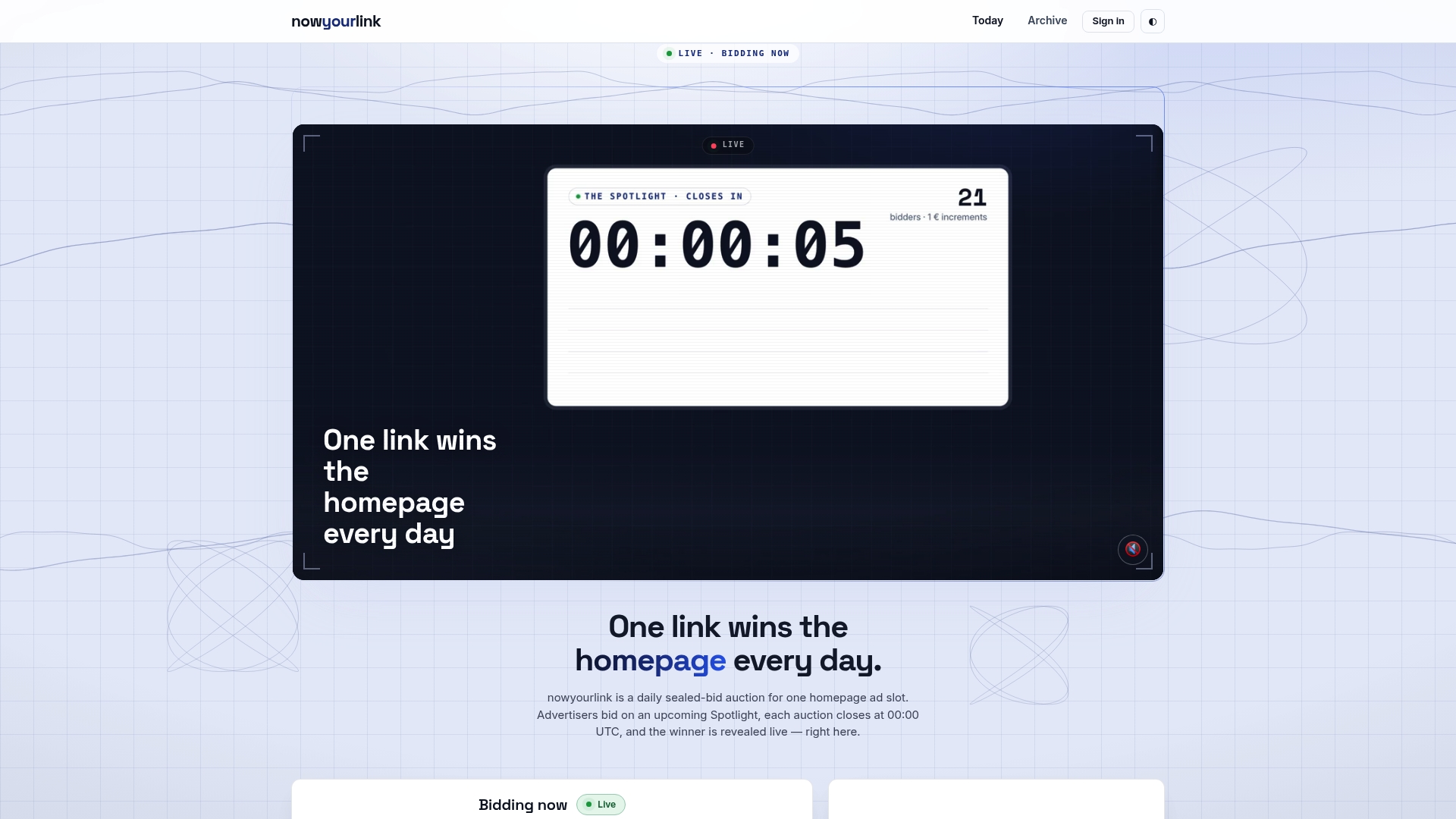
For SaaS brands, that means owning the page during a launch week without committing to a retainer or an ongoing media contract. Check Spotlight for SaaS for details built around product launches and feature announcements. For agencies, Spotlight for agencies explains how to resell a clean, verified, exclusive placement to clients, complete with bid history and live auction status for full transparency. Create a free account, watch how a live auction closes, and submit your first bid when a date matches your next campaign.
Sources
- Exclusive placement in online advertising (Columbia Business School)
- Auction mechanics: from Christie’s to Google Ads — Artem Papilov
- Learning optimal bidding policies and estimating ad effects (arXiv)
FAQ
What Is Sealed Bid Advertising?
Sealed-bid advertising is a daily auction where advertisers submit hidden bids for one exclusive homepage ad slot, with the highest bidder revealed at a fixed time and their creative shown alone for 24 hours.
How Is a Sealed Bid Auction Different From an Open Auction?
In a sealed-bid auction, bidders never see competing bids before the deadline, unlike an open auction where prices are visible and bidders can react in real time.
How Do I Win a Sealed Bid Auction Without Overpaying?
Estimate the campaign’s expected value first, then shade your bid below that ceiling, since first-price sealed-bid formats mean you pay exactly what you bid with no discount.
Is Sealed Bid Homepage Advertising Worth It for a Small Brand?
It works best when a single day of total attention matters more than ongoing frequency, such as a launch or limited-time offer, rather than as a routine, everyday ad buy.
Can Agencies Resell Sealed Bid Homepage Slots to Clients?
Yes. Platforms like Nowyourlink’s Spotlight for agencies offer verified, transparent bidding that agencies can bundle with creative production or brand-lift reporting for client campaigns.